AI Literacy: The New Core Skill Employers Are Looking for in Your Resume
Learn how to showcase AI literacy on your resume in 2026. Discover what employers expect, which AI tools matter, and how to highlight your skills effectively.
Artificial intelligence is no longer a futuristic concept limited to tech companies and research labs. In 2026, AI has become a standard tool across almost every industry, from marketing and finance to healthcare and education. As a result, employers are increasingly looking for candidates who understand how to work with AI tools, not just as specialists, but as professionals who can integrate AI into their daily work.
This shift has created a new baseline skill: AI literacy. It is no longer enough to simply know your field. Employers now expect you to demonstrate that you can use AI to work smarter, make better decisions, and deliver results faster. Your resume is the first place where you need to show this capability.
In this guide, you will learn what AI literacy means for job seekers in 2026, why it matters to employers, how to identify the right AI skills for your industry, and how to present them effectively on your resume.
What Is AI Literacy?
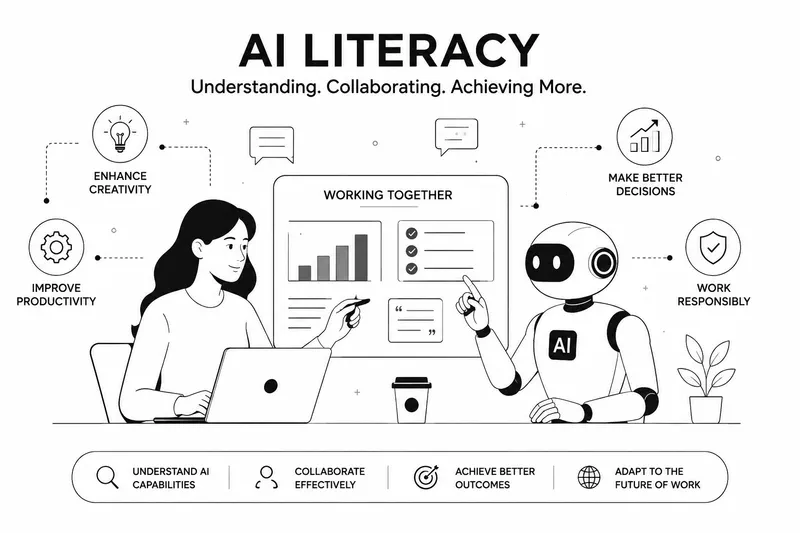
AI literacy is the ability to understand, use, and critically evaluate artificial intelligence tools and systems in a professional context. It goes beyond knowing how to use ChatGPT or other AI assistants. AI literacy includes:
- Understanding AI capabilities and limitations – knowing what AI can and cannot do well
- Prompt engineering – the skill of giving clear, effective instructions to AI tools
- Evaluating AI outputs – checking AI-generated content for accuracy, bias, and relevance
- Integrating AI into workflows – using AI to automate tasks, generate insights, or enhance creativity
- Ethical awareness – understanding data privacy, bias, and responsible AI use
In short, AI literacy is not about becoming a data scientist or machine learning engineer. It is about being a competent and confident user of AI in your specific role, whether you are a marketer, project manager, accountant, or customer service professional.
Why AI Literacy Matters to Employers in 2026
The demand for AI literacy has grown rapidly. According to recent data, 53% of hiring managers believe that AI literacy will be a baseline requirement for most entry-level roles within the next two years. This is not just for technical positions. Employers across all functions expect candidates to be comfortable with AI tools.
There are several reasons for this shift:
- Productivity expectations – companies see AI as a way to increase efficiency. Candidates who can use AI effectively are seen as more productive from day one.
- Competitive advantage – organizations want employees who can leverage AI to generate better insights, create better content, and make better decisions.
- Cost savings – AI tools can reduce the time spent on repetitive tasks, allowing employees to focus on higher-value work.
- Innovation culture – companies want teams that are curious, adaptable, and willing to adopt new technologies.
- Use AI writing assistants (ChatGPT, Claude, Gemini, Copilot)
- Create AI-generated images or presentations (Midjourney, Canva AI)
- Analyze data with AI-powered tools (Power BI, Tableau AI features)
- Automate workflows (Zapier, Make, Microsoft Power Automate)
- Generate summaries, reports, or meeting notes using AI
- Programming in Python, R, or similar languages
- Working with machine learning frameworks (TensorFlow, PyTorch)
- Understanding neural networks, NLP, or computer vision
- Deploying AI models in production environments
- Using AI for content ideation and drafting (ChatGPT, Jasper, Copy.ai)
- Creating visuals with AI image generators (Midjourney, DALL-E, Canva AI)
- Analyzing campaign performance with AI-powered analytics
- Personalizing email and ad content using AI segmentation tools
- Using SEO tools with AI features (SurferSEO, Semrush)
- Using AI for lead scoring and prioritization
- Generating outreach emails and follow-up messages with AI assistants
- Analyzing customer interactions with AI-powered CRM tools
- Creating sales presentations with AI design tools
- Summarizing meeting notes and action items using AI transcription
- Using AI to screen resumes and identify top candidates
- Creating job descriptions with AI writing tools
- Summarizing interview notes and candidate feedback
- Using AI for employee engagement surveys and sentiment analysis
- Automating onboarding documentation and workflows
- Using AI for expense categorization and receipt processing
- Generating financial summaries and reports with AI tools
- Using AI-powered forecasting and trend analysis
- Automating data entry and reconciliation with AI workflows
- Detecting anomalies and potential fraud using AI analytics
- Using AI to generate project plans and timelines
- Summarizing meeting minutes and tracking action items
- Using AI for risk assessment and resource allocation
- Automating status report generation
- Using predictive analytics to anticipate delays or issues
- Using AI chatbots to handle common inquiries
- Generating response templates with AI writing tools
- Analyzing customer sentiment with AI-powered feedback tools
- Summarizing support tickets and identifying recurring issues
- Using AI for multilingual customer communication
- Using AI to generate design variations and concepts
- Automating repetitive design tasks with AI plugins
- Using AI for color palette and layout suggestions
- Creating mockups and prototypes faster with AI tools
- Using AI for image editing and enhancement
- Used ChatGPT and Claude to draft blog posts, email campaigns, and social media copy, reducing content creation time by 40% while maintaining quality and consistency.
- Leveraged AI-powered data analysis tools to identify customer trends and generate weekly performance reports, improving reporting speed by 55%.
- Integrated AI chatbots into the customer support workflow, reducing average response time from 4 hours to 15 minutes.
- Used AI transcription and summarization tools to document meeting notes, saving 10+ hours per week in administrative tasks.
- Collaborated with AI tools to generate design mockups and prototypes, reducing project iteration time by 30%.
- Use ChatGPT to help you brainstorm ideas or improve your writing
- Try Canva AI to create visuals or presentations
- Experiment with AI meeting transcription tools (Otter.ai, Fireflies.ai)
- Use Microsoft Copilot or Google Gemini to assist with email drafting and document creation
- Google offers AI training through its AI Essentials course
- LinkedIn Learning has AI literacy courses for non-technical professionals
- Coursera and Udemy offer beginner-friendly AI courses
- Microsoft offers Copilot training and certification
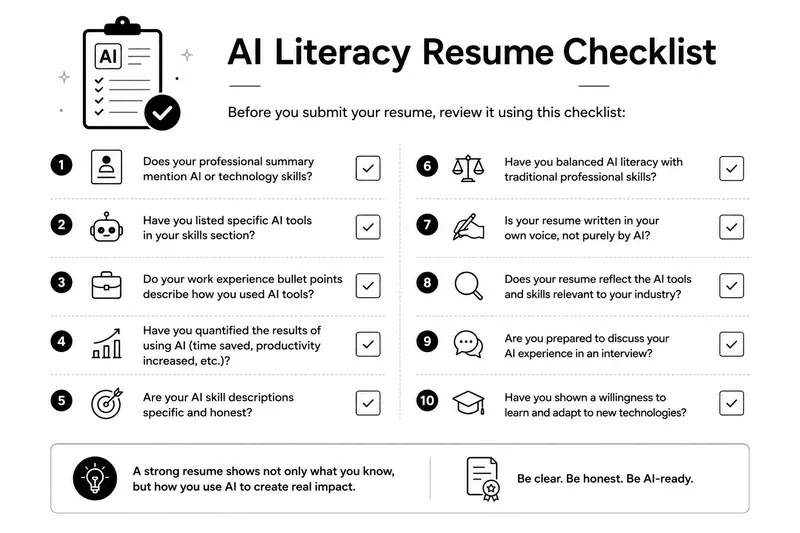
- Does your professional summary mention AI or technology skills?
- Have you listed specific AI tools in your skills section?
- Do your work experience bullet points describe how you used AI tools?
- Have you quantified the results of using AI (time saved, productivity increased, etc.)?
- Are your AI skill descriptions specific and honest?
- Have you balanced AI literacy with traditional professional skills?
- Is your resume written in your own voice, not purely by AI?
- Does your resume reflect the AI tools and skills relevant to your industry?
- Are you prepared to discuss your AI experience in an interview?
- Have you shown a willingness to learn and adapt to new technologies?
The presence of AI-related terms in resumes has increased significantly, from 3.7% in 2023 to 12.8% in 2025. This trend continues to grow in 2026, making AI literacy an increasingly important differentiator in a competitive job market.
AI Literacy vs. AI Expertise: What Employers Actually Expect
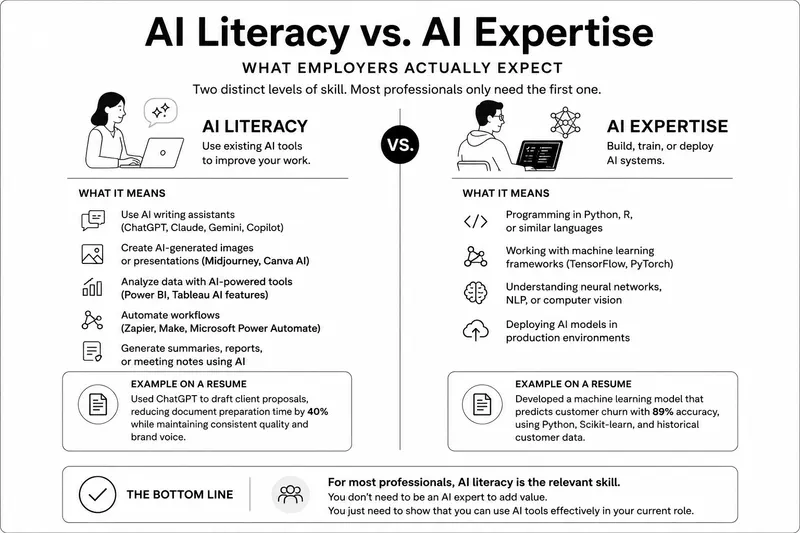
It is important to understand the difference between AI literacy and AI expertise. These are two distinct levels of skill, and most job seekers only need the first one.
AI literacy
AI literacy means you can use existing AI tools to improve your work. You do not need to build AI models or understand complex algorithms. Instead, you need to know how to:
Example of AI literacy on a resume:
Used ChatGPT to draft client proposals, reducing document preparation time by 40% while maintaining consistent quality and brand voice.
AI expertise
AI expertise means you can build, train, or deploy AI systems. This is required for roles such as machine learning engineer, data scientist, AI researcher, or AI product manager. Expertise includes:
Example of AI expertise on a resume:
Developed a machine learning model that predicts customer churn with 89% accuracy, using Python, Scikit-learn, and historical customer data.
For most professionals, AI literacy is the relevant skill. You do not need to be an AI expert to add value. You just need to show that you can use AI tools effectively in your current role.
How to Identify AI Skills for Your Industry
AI literacy looks different in every industry. The tools you use and the way you apply them will depend on your role, your field, and the specific needs of your employer. Here are examples of how AI literacy applies across different professions:
Marketing and content creation
Sales and business development
Human resources and recruiting
Finance and accounting
Project and operations management
Customer service and support
Design and creative roles
How to Write About AI Literacy on Your Resume
Once you have identified the AI tools and skills relevant to your role, you need to present them effectively on your resume. The key is to be specific and results-oriented. Do not just list AI tools. Show how you used them and what you achieved.
1. Include AI tools in your skills section
Create a dedicated skills section that lists both traditional and AI-powered tools. This helps ATS systems and recruiters quickly see your technical capabilities.
Example skills section:
Skills: Project Management, Agile Methodology, Stakeholder Communication, Risk Management, Microsoft Project, Jira, Asana, ChatGPT, Claude, Microsoft Copilot, AI-Powered Reporting Tools
2. Add AI literacy to your professional summary
Your resume summary is one of the first things recruiters see. Including AI literacy here can immediately position you as a modern, tech-savvy candidate.
Example professional summary:
Marketing professional with 5+ years of experience in content strategy, digital campaigns, and brand management. Skilled in using AI tools to accelerate content creation, analyze campaign performance, and generate data-driven insights. Increased content output by 35% by integrating AI writing assistants into the content workflow.
3. Describe AI use in your work experience bullet points
The most convincing way to show AI literacy is to include it in your work experience. Describe specific tasks where you used AI and quantify the results.
Examples:
4. Mention AI literacy in your achievements and projects
If you have completed specific projects or initiatives involving AI, highlight them separately. This is especially useful if AI played a significant role in your work.
Example achievement:
Led the adoption of AI writing tools across a 12-person content team, resulting in a 28% increase in content production and a 15% improvement in engagement metrics within three months.
AI Literacy Resume Examples by Industry
Use these examples as inspiration, but adapt them to your specific experience and the tools you actually use. Being honest and specific is always more important than using impressive-sounding keywords.
Marketing resume with AI literacy
Professional summary:
Digital marketing specialist with 4+ years of experience in content strategy, SEO, email campaigns, and paid social advertising. Skilled in using AI tools for content ideation, copywriting, and performance analysis. Increased organic traffic by 45% using AI-powered SEO recommendations and topic clustering.
Work experience bullet point:
Used ChatGPT and Jasper to generate content outlines and draft blog posts, reducing writing time by 35% and maintaining consistent brand voice across 50+ articles.
Project management resume with AI literacy
Professional summary:
Project manager with 6+ years of experience leading cross-functional teams and delivering complex projects on time and within budget. Adept at using AI tools for project planning, risk assessment, status reporting, and stakeholder communication. Reduced project delays by 25% by implementing AI-powered tracking and predictive analytics.
Work experience bullet point:
Used AI meeting transcription and summarization tools to document stakeholder meetings, ensuring 100% action item capture and follow-through across 10+ concurrent projects.
Finance resume with AI literacy
Professional summary:
Finance analyst with 4+ years of experience in budgeting, forecasting, variance analysis, and financial reporting. Skilled in using AI-powered analytics tools to accelerate data processing and generate actionable insights. Improved reporting efficiency by 40% through AI-driven data extraction and visualization.
Work experience bullet point:
Leveraged AI tools to automate expense categorization and reconciliation, reducing monthly close time from 10 days to 6 days.
Human resources resume with AI literacy
Professional summary:
HR specialist with 5+ years of experience in recruitment, onboarding, employee engagement, and HR operations. Experienced in using AI tools to screen resumes, draft job descriptions, and analyze employee sentiment. Reduced time-to-hire by 30% by implementing AI-powered candidate matching.
Work experience bullet point:
Used AI resume screening tools to identify qualified candidates faster, reducing initial screening time from 8 hours to 2 hours per role.
Customer service resume with AI literacy
Professional summary:
Customer support team lead with 5+ years of experience managing high-volume support operations and improving customer satisfaction. Skilled in using AI chatbots, sentiment analysis tools, and AI-powered response generation. Improved average response time from 3 hours to 20 minutes using AI support tools.
Work experience bullet point:
Led the integration of AI-powered chatbots for tier-1 support, resolving 45% of inquiries without human intervention and maintaining a 94% customer satisfaction score.
What Not to Do When Writing About AI Literacy
While AI literacy is valuable, there are also mistakes you should avoid. These can make your resume look weak or even dishonest.
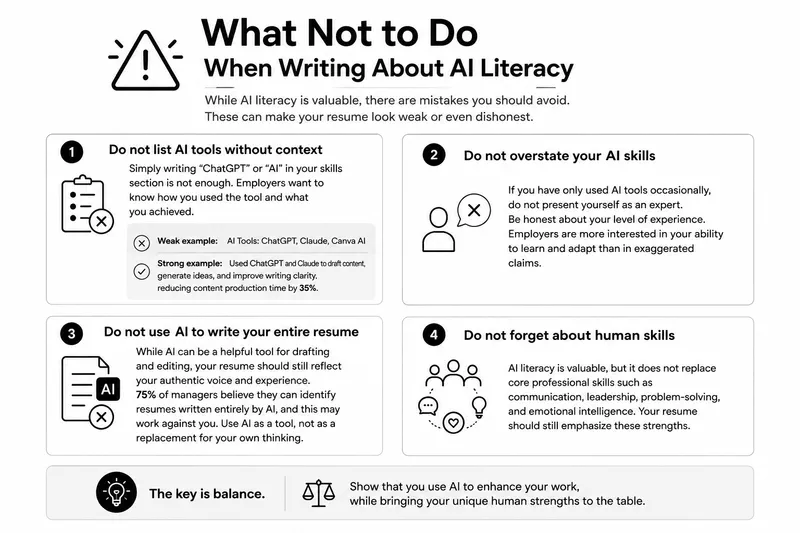
Do not list AI tools without context
Simply writing "ChatGPT" or "AI" in your skills section is not enough. Employers want to know how you used the tool and what you achieved.
Weak example: AI Tools: ChatGPT, Claude, Canva AI
Strong example: Used ChatGPT and Claude to draft content, generate ideas, and improve writing clarity, reducing content production time by 35%.
Do not overstate your AI skills
If you have only used AI tools occasionally, do not present yourself as an expert. Be honest about your level of experience. Employers are more interested in your ability to learn and adapt than in exaggerated claims.
Do not use AI to write your entire resume
While AI can be a helpful tool for drafting and editing, your resume should still reflect your authentic voice and experience. 75% of managers believe they can identify resumes written entirely by AI, and this may work against you. Use AI as a tool, not as a replacement for your own thinking.
Do not forget about human skills
AI literacy is valuable, but it does not replace core professional skills such as communication, leadership, problem-solving, and emotional intelligence. Your resume should still emphasize these strengths.
How to Develop Your AI Literacy
If you feel that your AI literacy is currently limited, do not worry. There are many ways to build this skill, and employers value candidates who are actively learning.
Start with free AI tools
Many AI tools offer free or low-cost versions that you can experiment with. Start by using them for everyday tasks:
Take online courses
There are many free and paid courses that can help you build AI literacy:
Learn prompt engineering
One of the most valuable AI skills is knowing how to write effective prompts. Practice giving clear, specific instructions to AI tools and refine your prompts based on the outputs you receive.
Stay curious and experiment
AI is evolving quickly. Follow industry news, join online communities, and try new tools as they emerge. Employers value candidates who are proactive about learning new technologies.
AI Literacy Resume Checklist
Before you submit your resume, review it using this checklist:
Frequently Asked Questions About AI Literacy and Resumes
Do I need AI literacy on my resume in 2026?
Yes. AI literacy is becoming a baseline expectation across many industries. Even if the job description does not mention AI, showing that you can use modern tools to work more efficiently is a strong advantage.
What if I do not have AI experience yet?
Start small. Experiment with free AI tools in your personal or professional life. Take an online course. Include a section on your resume that shows you are actively learning new AI skills.
Should I include AI tools I have only used casually?
Yes, but be honest about your experience level. You can write "familiar with" or "basic experience with" if you are still learning.
Can AI literacy help me get a job in a non-technical role?
Absolutely. AI literacy is valuable in marketing, HR, finance, project management, customer service, operations, and many other fields. Employers in all industries are looking for candidates who can leverage AI to improve productivity and decision-making.
How do I talk about AI literacy in an interview?
Be ready to share specific examples of how you have used AI tools to save time, improve quality, or solve problems. Focus on the results you achieved, not just the tools you used.
Is it risky to mention AI on my resume?
Not if you are honest and specific. Some employers may be cautious about candidates who rely too heavily on AI, but most view AI literacy as a positive skill. The key is to show that you use AI as a tool to enhance your work, not as a replacement for your skills or judgment.
Build a Modern Resume with mondoCV
AI literacy is one of the most important skills you can highlight on your resume in 2026. But presenting it effectively requires a clean, professional, and well-structured resume that makes your skills easy to find and understand.
With mondoCV, you can create a polished resume that highlights your AI literacy and other key skills. You can organize your experience, add a professional summary, and customize your sections to match the job you are applying for.
Use the examples and tips in this guide to identify your AI skills, write about them effectively, and build a resume that stands out to both recruiters and ATS systems.
Create your professional resume with mondoCV and build a resume that reflects your skills, experience, and readiness for the AI-powered workplace.
Was this article useful?
Your feedback helps us improve future CV and career guides.
Comments (0)
Loading comments...