The 2-Page Resume Myth: Why Two Pages Are the New Standard in 2026
Discover why the two-page resume is becoming the new standard in 2026. Learn when to use one page versus two and how to make every page count.
The one-page resume rule is one of the most persistent myths in career advice. For decades, job seekers have been told to cram their entire professional story onto a single sheet of paper. But in 2026, this rule is not only outdated—it is actively hurting qualified candidates.
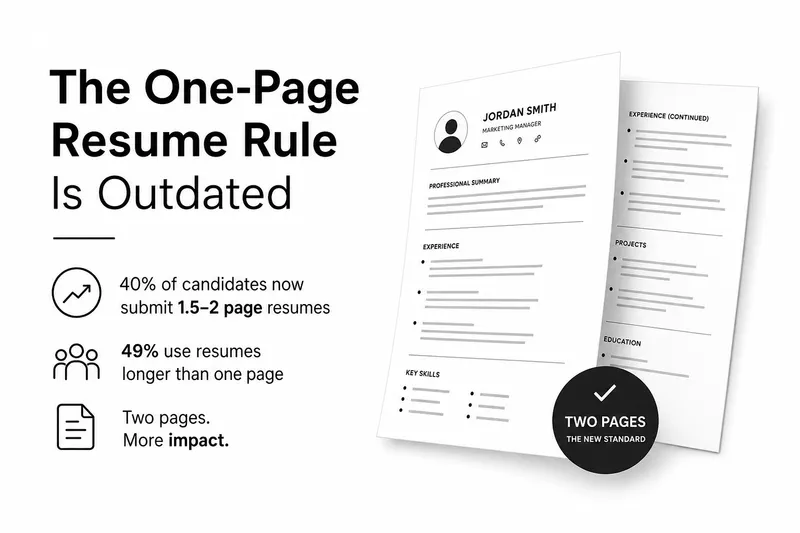
Data from Monster's 2026 State of Resumes Report shows that 40% of candidates now submit resumes between 1.5 and 2 pages, signaling a clear shift away from the one-page standard. Nearly half of all job seekers (49%) use resumes longer than one page, and 30% go to two pages or more.
This change reflects longer career timelines, the rise of skills-based hiring, and the growing pressure to demonstrate value quickly in an increasingly automated hiring process. In this guide, you will learn why two-page resumes have become the new standard, when to use them, and how to make every page work for you.
The Shift: Why the One-Page Rule Is Outdated
The one-page rule was never meant to be universal. It was originally designed for students, fresh graduates, and early-career professionals with naturally limited experience. In an era of printed resumes and paper folders, a single page made practical sense for recruiters carrying stacks of applications.
Today, hiring has moved almost entirely online. Recruiters review resumes on screens, and applicant tracking systems (ATS) parse documents digitally rather than physically. This has fundamentally changed what employers expect. According to a 2026 survey, 54% of hiring managers now prefer two-page resumes.
Several factors are driving this shift:
- Longer career timelines: Professionals change jobs more often and accumulate more experience across multiple employers
- Skills-based hiring: Employers want to see technical skills, tools, and certifications that require additional space
- ATS keyword requirements: Job seekers feel pressure to include more keywords to pass automated screening
- Remote and hybrid work: Skills like digital collaboration and remote tool proficiency need to be highlighted
Resumes are no longer static documents; they're evolving alongside how hiring actually works. Job seekers know the rules are changing, but many are still unsure how to respond.
The Data: What Hiring Managers Actually Prefer in 2026
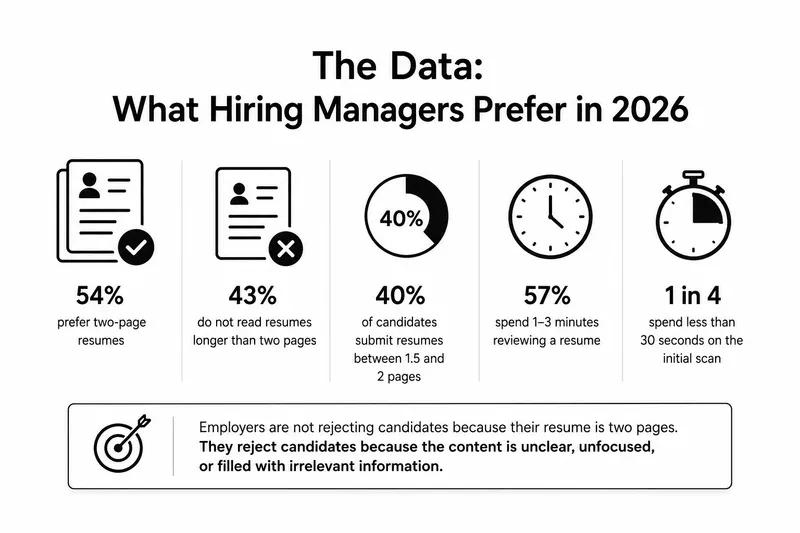
The data is clear about what recruiters want. According to recent surveys:
- 54% of hiring managers prefer two-page resumes over one-page documents
- 43% of hiring managers say they do not read resumes longer than two pages
- 40% of candidates submit resumes between 1.5 and 2 pages
- 57% of hiring managers spend 1–3 minutes reviewing a resume, so clarity matters more than brevity
- 1 in 4 hiring managers spend less than 30 seconds on the initial scan
These numbers show a clear pattern. Employers are not rejecting candidates because their resume is two pages. They reject candidates because the content is unclear, unfocused, or filled with irrelevant information.
When a Two-Page Resume Is the Right Choice
A two-page resume is not for everyone. It works best when you have enough relevant experience to justify the extra space. Here is a simple guide based on your career stage:
| Career Stage | Recommended Length | Why |
|---|---|---|
| Entry-Level (0–2 years) | 1 page | Limited experience. Focus on education, internships, and core skills |
| Early Career (2–5 years) | 1 page | Still building experience. Can expand if content is strong |
| Mid-Career (5–10 years) | 1–2 pages | Enough experience to justify 2 pages. Every line must add value |
| Senior (10–15 years) | 2 pages | Include detailed achievements for recent roles |
| Executive (15+ years) | 2–3 pages | Leadership achievements, board roles, and strategic initiatives |
A two-page resume makes particular sense for:
- Product, tech, data, or design roles where you need to list projects and technical skills
- Consulting or finance positions where detailed project experience is expected
- Career changers who need space to show how past experience translates to a new field
- Senior individual contributors and managers who have delivered measurable impact across multiple roles
When Two Pages Can Hurt You
A two-page resume becomes a problem when the second page is filled with weak content. Recruiters notice padding, and it works against you. Signs that your two-page resume is a problem include:
- Repeated responsibilities across different roles without showing progression
- Generic task descriptions that could apply to anyone
- Outdated or irrelevant experiences from more than 10–15 years ago
- Filler skills that take up space without adding value
- Content stretching to artificially fill a second page
A two-page resume should feel deliberate—not accidental. Page two should add signal, not noise. A sharp 1.7-page resume is strong. A bloated two-page resume is forgettable.
What About ATS? Does a Two-Page Resume Hurt You?
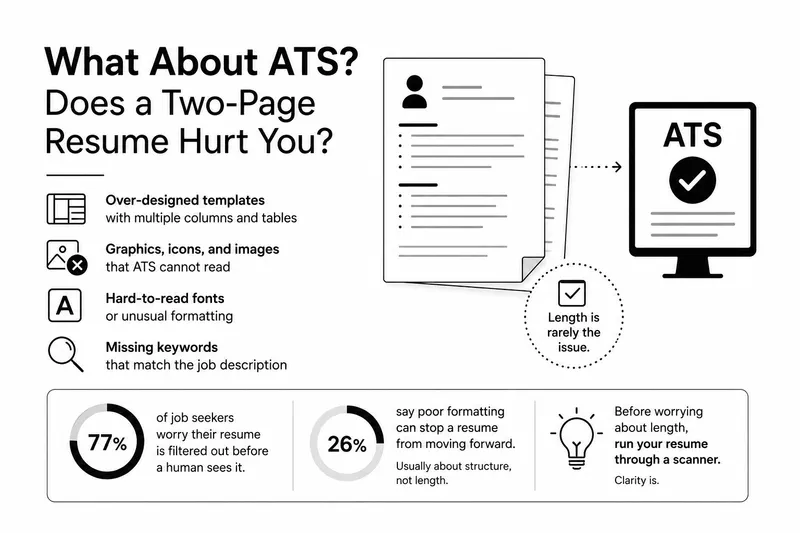
One of the biggest fears job seekers have is that a two-page resume will get rejected by an applicant tracking system. This fear is largely unfounded. Modern ATS systems are designed to parse multi-page documents without issues.
What hurts your resume with ATS is not the length, but:
- Over-designed templates with multiple columns and tables
- Graphics, icons, and images that ATS cannot read
- Hard-to-read fonts or unusual formatting
- Missing keywords that match the job description
According to recent data, 77% of job seekers express concern that their resume is filtered out before reaching a human reviewer. However, only 26% say poor formatting can stop a resume from moving forward, and this is usually about structure, not length.
Before worrying about length, run your resume through a scanner. Length is rarely the issue. Clarity is.
How to Write a Strong Two-Page Resume
If a two-page resume is right for you, here is how to make every inch of space work hard. The key principle is simple: quality over quantity.
1. Make page one undeniable
Recruiters spend most of their time on the first page. If page one does not hook them, they may never reach page two. Lead with your strongest achievements, most relevant experience, and key skills. Ask yourself: if someone only reads half your resume, are they impressed?
2. Prioritize the last 7–10 years
Recent experience matters most. Provide detailed bullet points for your last 1–2 roles, especially if they are directly relevant to the job. For older roles, use fewer bullet points or combine them with a brief summary.
3. Quantify your achievements
Numbers make your resume more convincing. Instead of listing responsibilities, show what you achieved. For example:
- Weak: "Managed a team of developers"
- Strong: "Led a team of 12 developers, delivering 5 major product releases on time and increasing deployment frequency by 40%"
4. Cut what does not serve the role
Every bullet point on your resume should earn its space. Before keeping any line, ask: does this prove impact? Does this make me more competitive for this specific job? Would I defend keeping this in an interview?
5. Keep formatting clean and ATS-friendly
Use clear headings, consistent spacing, and standard fonts. Avoid multiple columns, tables, images, or excessive color. A simple, text-based layout is the safest choice for both ATS and human readers.
Examples: One-Page vs. Two-Page Resumes
Here is how the same professional might approach their resume differently at different career stages.
Entry-Level (One Page)
Professional summary: Recent computer science graduate with internship experience in web development. Skilled in JavaScript, Python, Git, and responsive design. Eager to apply technical and problem-solving skills in a software development role.
Experience:
- Software Development Intern – TechStart Inc. (6 months)
- Built responsive web components using React and JavaScript
- Assisted with database testing and bug fixes
- Education: B.S. Computer Science, GPA 3.7
- Skills: JavaScript, Python, Git, HTML/CSS, SQL
Mid-Career (Two Pages)
Professional summary: Full-stack software developer with 7+ years of experience building scalable web applications. Skilled in JavaScript, Python, React, Node.js, and cloud deployment. Led teams of up to 8 developers and delivered products used by 50,000+ users.
Experience (detailed for last 2 roles):
- Senior Software Developer – CloudTech Solutions (2021–present)
- Led a team of 8 developers, delivering 5 major product releases on time
- Reduced page load time by 40% through code optimization and caching strategies
- Mentored 3 junior developers and improved team velocity by 25%
- Designed and deployed microservices architecture using Node.js and AWS
- Software Developer – DataFlow Systems (2017–2021)
- Built RESTful APIs and integrated with third-party services
- Improved database query performance by 35%
- Collaborated with product and design teams on feature planning
Education and certifications on page two.
What Recruiters Actually Look For
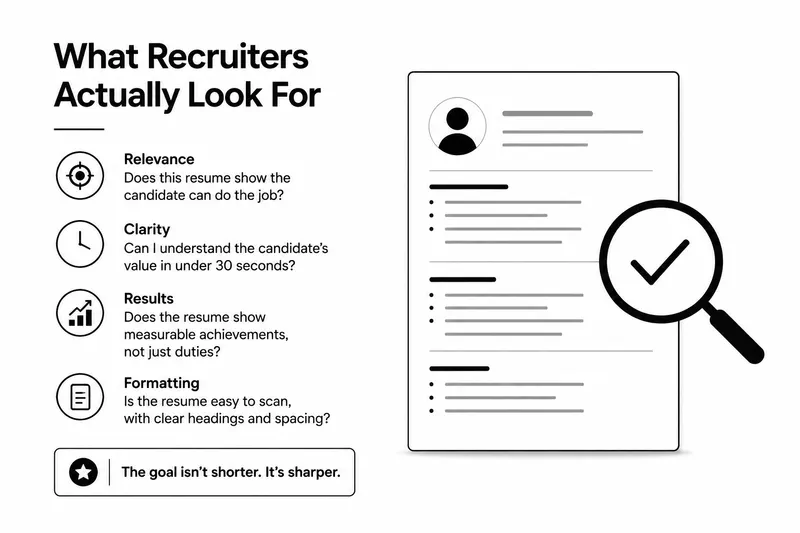
Recruiters do not reject resumes because they are two pages. They reject them because they are unclear, unfocused, or hard to read. Here is what hiring managers actually care about:
- Relevance: Does this resume show the candidate can do the job?
- Clarity: Can I understand the candidate's value in under 30 seconds?
- Results: Does the resume show measurable achievements, not just duties?
- Formatting: Is the resume easy to scan, with clear headings and spacing?
The goal isn't shorter. It's sharper.
Common Resume Length Mistakes to Avoid
Here are the most common mistakes job seekers make when deciding on resume length.
1. Padding to fill two pages
If you are at one-and-a-half pages and stretch content to fill two, recruiters will notice. A tight one-and-a-half-page resume reads better than a padded two-page version.
2. Cutting important content to fit one page
If forcing one page means omitting your most impressive achievements or key career progression details, the page constraint is hurting you. Go to two.
3. Using buzzwords instead of proof
Resumes full of words like "hardworking," "passionate," or "innovative" without supporting evidence waste space. Use concrete examples and numbers instead.
4. Including outdated information
For most professionals, roles from 10+ years ago can be summarized in 1–2 bullet points. The last 7–10 years matter most.
5. Over-designing your resume
Multiple colors, icons, images, or complex layouts may look creative but hurt readability and ATS performance. 62% of hiring managers say overly designed resumes negatively affect their perception.
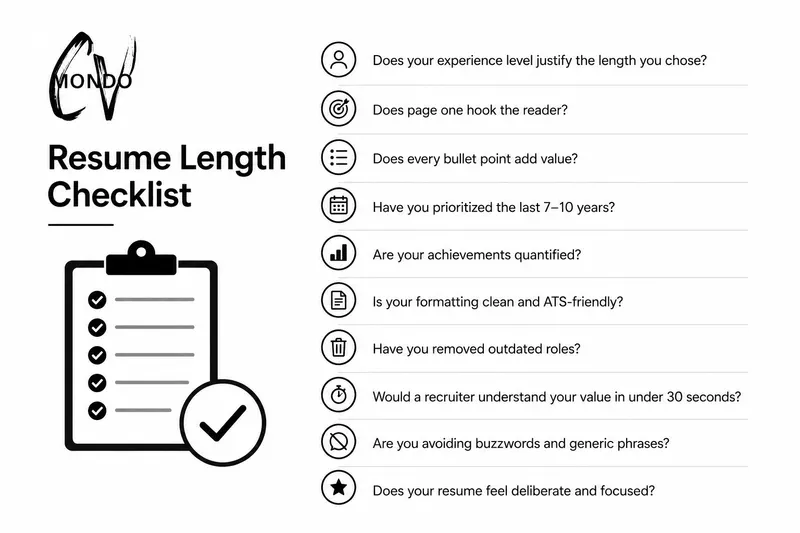
Resume Length Checklist
Before you submit your resume, review it using this checklist:
- Does your experience level justify the length you chose?
- Does page one hook the reader with your strongest achievements?
- Does every bullet point add value or prove impact?
- Have you prioritized the last 7–10 years of experience?
- Are your achievements quantified with numbers where possible?
- Is your formatting clean, consistent, and ATS-friendly?
- Have you removed outdated roles or responsibilities that no longer matter?
- Would a recruiter understand your value in under 30 seconds?
- Are you avoiding buzzwords and generic phrases?
- Does your resume feel deliberate and focused, not accidentally long?
Frequently Asked Questions About Resume Length
Is a two-page resume okay in 2026?
Yes. Data shows that 54% of hiring managers prefer two-page resumes, and 40% of candidates now submit resumes between 1.5 and 2 pages. The one-page rule is outdated for experienced professionals.
Should a student use a two-page resume?
No. Students and recent graduates with limited experience should stick to one page. Focus on education, internships, projects, and core skills.
Can a two-page resume hurt me with ATS?
No. Modern ATS systems parse multi-page resumes without issues. What hurts you is poor formatting, images, tables, or missing keywords.
What if I have a 10-year career but cannot fill two pages?
That is fine. Do not force a second page if you do not have enough strong content. A sharp one-page resume is better than a padded two-page version.
How do I decide between one and two pages?
Use your experience level as a guide. Entry-level (0–2 years): one page. Mid-career (5–10 years): one to two pages. Senior and executive (10+ years): two pages is standard.
Can a resume be more than two pages?
For most roles, no. 43% of hiring managers do not read resumes longer than two pages. The exceptions are academic, medical, and federal roles, where CVs can be longer.
Build the Right Resume Length for Your Career with MondoCV
The shift to two-page resumes reflects a larger truth about modern hiring: employers care about the quality and relevance of your content, not the number of pages. In 2026, the resume that wins is the resume that is clear, focused, and packed with proof of your value.
With MondoCV, you can build a clean, professional, and ATS-friendly resume at exactly the right length for your career stage. You can organize your experience, highlight your achievements, and create a resume that works for both recruiters and automated systems.
Use the guidance in this article to decide what length works for you. Then build a resume that tells your story clearly, deliberately, and with impact.
Create your professional resume with MondoCV and build a resume that gets noticed.
Was this article useful?
Your feedback helps us improve future CV and career guides.
Comments (0)
Loading comments...
More articles like this
All articlesResume Summary Examples for 2026: How to Write a Professional Summary That Gets Interviews
Learn how to write a professional resume summary that highlights your skills, experience, and achievements while improving your chances of passing ATS screenings and impressing recruiters.
Read the guideHow to Beat ATS in 2026: The Complete Guide to ATS-Friendly Resumes
Up to 75% of resumes are rejected by Applicant Tracking Systems before a human sees them. Learn the exact formatting rules, keyword strategies, and optimization techniques to make sure your resume passes ATS screening every time.
Read the guide